From Bystander to the Inside: How Indian Law Embedded Itself in Technology
The law is no longer a judge standing above the machine. It is embedded inside the machine.
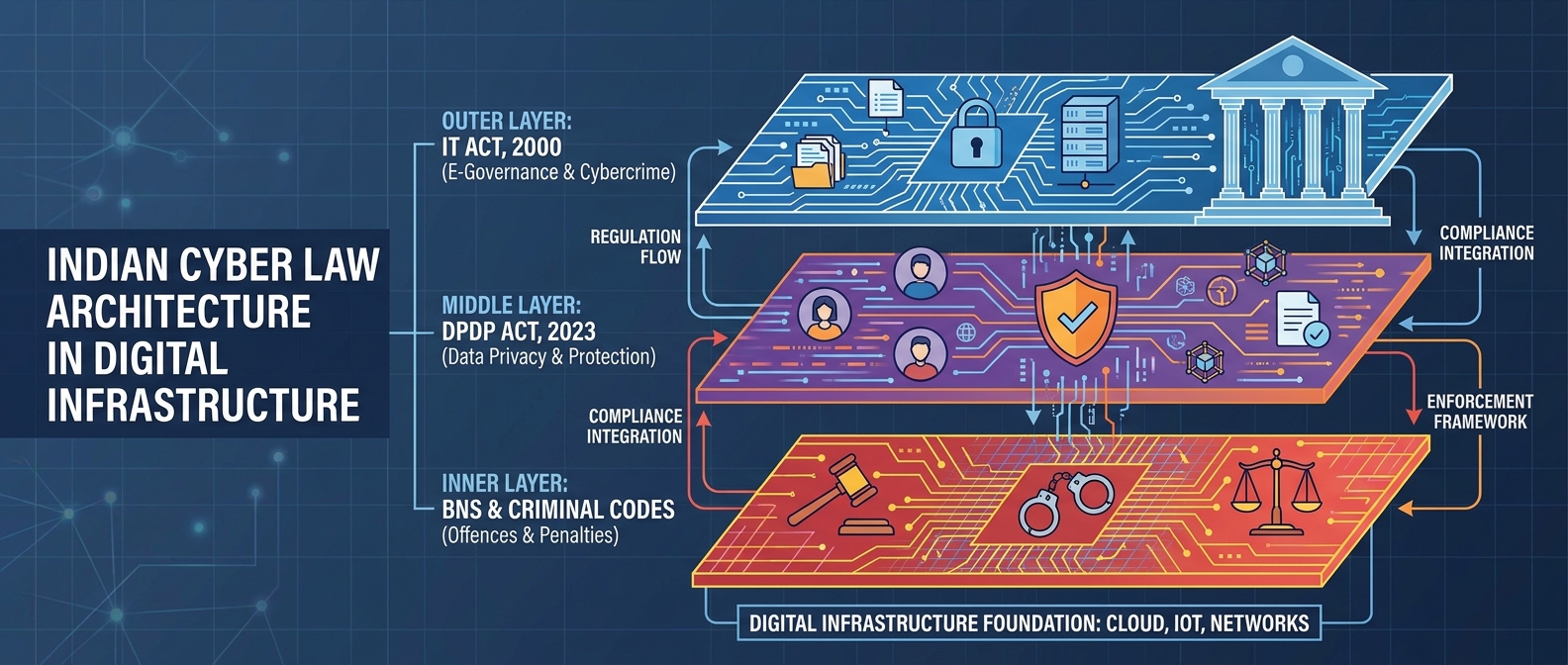
In India, the legal system governing technology has mutated from a scattered set of statutes into an integrated operating system. To understand it, you cannot read laws in isolation anymore. You must read them like interacting protocols — each layer handing authority to the next.
From thirty thousand feet, the architecture is brutally simple: permission, control, enforcement.
The Foundation: A Three-Body Problem
Modern Indian digital law is no longer a single act. It is a gravitational system of three massive bodies pulling against each other.
1. The Information Technology Act, 2000
The IT Act is the fossil layer. It was drafted for an internet that still believed cyberspace was separate from reality.
It legalized electronic records. It recognized digital signatures. It criminalized primitive forms of hacking. It created the original vocabulary of Indian cyber law.
But today, the IT Act feels like infrastructure buried beneath a megacity — still load-bearing, still essential, but no longer sufficient to explain the skyline above it.
It is the skeleton. Not the organism.
2. The Digital Personal Data Protection Act, 2023
The DPDP Act changed the philosophical center of Indian tech regulation.
The state no longer sees data merely as information. It sees it as custody.
You are not the owner of user data. You are its temporary custodian. A fiduciary. A handler of borrowed identity.
The shift is subtle but enormous.
Under the IT Act, data breaches were security failures. Under DPDP, they become breaches of trust.
The law now asks questions engineers once ignored:
- Why are you collecting this data?
- How long are you keeping it?
- Can the user withdraw consent?
- Can you prove purpose limitation?
- Can you survive an audit trail?
This is no longer “compliance.” This is behavioral governance through financial pressure.
The state does not need to imprison every violator. It only needs penalties large enough to alter corporate metabolism.
3. The Criminal Code Triad: BNS, BSA, BNSS
This is where the atmosphere changes.
As of 2024, India replaced its colonial criminal framework with three new statutes: the Bharatiya Nyaya Sanhita, the Bharatiya Sakshya Adhiniyam, and the Bharatiya Nagarik Suraksha Sanhita.
Together, they are not merely legal replacements. They are an expansion of state capability into the digital substrate itself.
The old legal system treated cybercrime as an annex. The new one treats it as native terrain.
The Descent Into Crime: Where Code Meets the Cell
A cybercrime used to be thought of as something abstract — anonymous packets crossing invisible borders.
The law no longer sees it that way.
Today, a cybercrime is treated as economically real, socially destabilizing, and nationally consequential. The distinction between “online” and “offline” harm is dissolving.
The result is that code increasingly inherits the legal weight once reserved for physical action.
1. The Overlap of Offenses
This is the most important shift most technologists still fail to understand.
The state no longer prosecutes cyber offenses vertically. It prosecutes horizontally.
If you compromise a system, you are not merely facing provisions under the IT Act for unauthorized access. The same act can now simultaneously activate fraud statutes, impersonation provisions, conspiracy charges, organized crime provisions, financial crime enforcement, and procedural powers under the new criminal codes.
One action. Multiple legal surfaces.
The machine has learned redundancy.
A phishing kit is no longer “just” cybercrime. It can become identity fraud, financial deception, criminal conspiracy, organized criminal activity, or even a threat to public order depending on scale.
The architecture is intentional: overlapping jurisdictions reduce escape vectors. If one statute fails, another remains operational.
2. The Logic of Evidence: The BSA Revolution
This may be the single most consequential change for engineers, SOC analysts, forensic investigators, and infrastructure teams.
Under the old evidentiary regime, digital records often existed in an awkward legal limbo. They required layered authentication and were treated with suspicion.
That era is ending.
Under the Bharatiya Sakshya Adhiniyam, electronic evidence has moved closer to the center of admissibility.
The implications are profound.
The Log Becomes Testimony
Your server logs are no longer operational artifacts. They are potential courtroom witnesses.
Retention policies now carry legal consequences. Missing logs can imply negligence. Manipulated logs can imply intent.
The Hash Enters the Courtroom
The law has finally absorbed a core truth of computer science: integrity is mathematical.
A hash mismatch is not a technical inconvenience. It is evidentiary decay.
If forensic images lack verifiable integrity, if timestamps drift, if chain-of-custody documentation breaks, the entire prosecution can fracture under procedural scrutiny.
The modern cyber investigator therefore operates in two domains simultaneously: technical certainty and legal admissibility. One without the other is useless.
Chain of Custody Is Now a Technical Discipline
In practice, this means DevOps engineers, cloud architects, SIEM administrators, and forensic responders are increasingly participating in legal architecture — whether they realize it or not.
Every backup policy is now partially a litigation strategy. Every access control decision is potentially discoverable. Every deleted record creates a future question.
3. Organized Cybercrime: The End of the “Lone Hacker” Myth
The new framework reflects a geopolitical realization: modern cybercrime is industrialized.
The law is adapting accordingly.
Under the Bharatiya Nyaya Sanhita, organized criminal activity receives significantly heavier treatment. This matters because many cyber operations naturally resemble networks rather than individuals: coordinated scam centers, ransomware affiliates, mule-account ecosystems, botnet operators, credential marketplaces, synthetic identity farms.
The state increasingly interprets scale itself as evidence of organized structure.
The psychological image of the hoodie-wearing lone hacker is legally obsolete. Today’s threat model is logistical, distributed, and economic.
The response is correspondingly heavier: asset seizure, expanded investigation powers, broader conspiracy framing, and penalties calibrated not merely for intrusion — but for systemic destabilization.
The Reality of the Grid
The structure now reveals itself clearly:
- The IT Act grants digital existence.
- The DPDP Act governs digital behavior.
- The new criminal framework governs digital consequence.
Together, they form a stack. Not a collection of laws — a stack.
And like all stacks, power flows downward: from identity, to data, to enforcement.
India is no longer regulating the internet as an external phenomenon. It is integrating digital activity into the core nervous system of governance itself.
The frontier phase is ending.
Cyberspace is being converted into administratively legible territory: mapped, logged, attributable, prosecutable.
Every packet leaves residue. Every authentication event becomes memory. Every line of code carries implied intent once it produces measurable harm.
The law does not need to understand your architecture diagram. It only needs to establish causality.
And increasingly, the machine can.
Keep your audit trails immutable. Keep your consent flows explicit. Keep your infrastructure explainable.
Because the modern legal state is no longer trying to merely observe technology.
It is trying to become native to it.
